The Psychology of Bubble Shooter: Why Simple Puzzle Games Are So Hard to Put Down
Almost everyone has done it. You open a bubble shooter to fill two minutes while a file uploads, and twenty minutes later you are still aiming at a cluster of blue circles, telling yourself that the next shot is definitely the last one. The game has no story and no real ending, yet it holds attention in a way far more ambitious titles often fail to manage.
That gap between apparent simplicity and real stickiness is worth taking seriously. Casual puzzle games are small machines built out of timing, feedback and expectation, and once you see the parts, the pull becomes far less mysterious. Free browser versions such as https://bubble-shooter-free.de make the pattern easy to observe, because nothing stands between you and the mechanic: no download, no tutorial, no narrative to distract from what the game is doing to your attention.
What Actually Makes a Casual Puzzle Game Compelling
The compelling part is almost never the theme. Bubbles, jewels, candies and fruit are interchangeable skins over the same structure. What matters is a clear goal, complete information about the board, and the ability to act immediately.
Three conditions do most of the work. The rules must be graspable in a single glance. Every action must produce a visible consequence. And the gap between deciding and finding out must be tiny — a second or two at most.
When those conditions hold, the game stops feeling like a task and starts feeling like a conversation. You propose a shot, the board answers, you propose another. That exchange is absorbing, and it has little to do with graphics or budget.
The Short Feedback Loop and Why Instant Visual Reward Matters
The loop runs: aim, shoot, watch, evaluate, aim again. In practice it takes a couple of seconds. Compare that to most of a working day, where the results of a decision may not be visible for weeks, or ever.
Instant feedback is unusually satisfying because it closes the uncertainty gap immediately. You do not have to hold your prediction in mind and wait. The bubbles pop, the colour disappears, the count updates, and you know exactly how good your judgement was.
The visual component matters too. A cluster vanishing with a burst of movement and sound is concrete, sensory confirmation that something happened. Abstract feedback — a number rising in a corner — is far weaker. The game converts your decisions into legible physical events.
Near-Misses and the “One More Go” Reflex
The shot that almost worked is more motivating than the shot that clearly failed. When a bubble lands one position short of a match, or clips a cluster and sticks instead of dropping it, the game has shown you that your plan was nearly correct.
A near-miss feels like information rather than defeat. It reads as “adjust the angle slightly” rather than “you cannot do this”. So the natural response is to try again immediately, while the correction is still fresh.
This is where the “one more go” reflex lives. It is often observed that people stop far more readily after a decisive outcome than an ambiguous one. A board lost by a wide margin is easy to walk away from. A board lost by two bubbles is not.
Variable Reward: Why Randomised Colours Keep Sessions Going
In a bubble shooter you can see the current bubble and usually the next one, but no further. Beyond that, the colour sequence is unknown. That single design choice does an enormous amount of work.
Because you cannot plan ten shots ahead, every draw carries a charge of anticipation. Sometimes the colour you need arrives at the perfect moment and a prepared structure collapses. Sometimes you get three useless bubbles and have to improvise. The reward is real but unpredictable in timing.
Unpredictable rewards sustain behaviour far longer than predictable ones. If you knew every colour in advance, the game would become a solvable exercise you would finish or abandon. Randomisation keeps the outcome open, which keeps the next shot interesting.
Flow and the Difficulty Sweet Spot
Flow is the state in which a task absorbs you completely: attention narrows, self-consciousness drops, and time seems to compress. It appears reliably when the challenge sits just above your current skill.
Too easy and the mind wanders. Too hard and you get frustrated and quit. The interesting territory is the narrow band between them, and well-designed casual games spend most of their time there.
Bubble shooters manage this by escalating gradually. Early boards forgive sloppy aiming; later boards punish it. The ceiling drops, the colour count rises, awkward overhangs appear. Your skill improves at a similar rate, so subjective difficulty stays constant while objective difficulty climbs.
Easy to Learn, Hard to Master
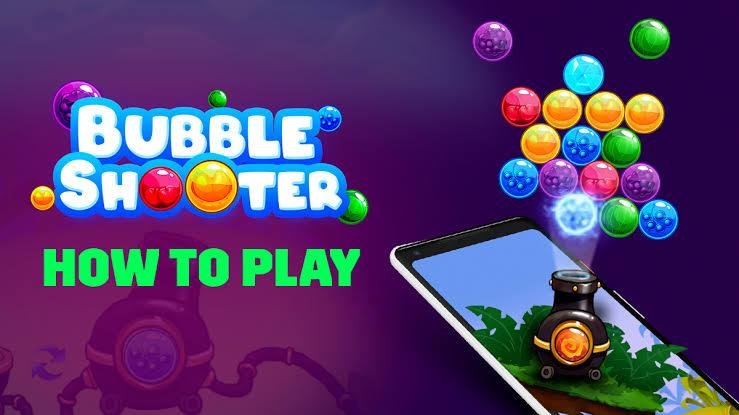
Nobody needs instructions for a bubble shooter. Point, shoot, match three. The entire rule set fits in one sentence, which is why the genre works for players of any age and requires no prior gaming experience.
Mastery is a different matter. Skilled play means reading the whole board rather than the nearest cluster, using wall bounces to reach otherwise unreachable positions, and parking unwanted colours where they do least damage.
Above all it involves thinking about what hangs below what. Advanced players do not aim for matches; they aim for the anchors holding large sections in place. That shift, from clearing what you see to engineering a collapse, is the real skill curve, and it is invisible to a beginner.
Why Big Cascades Feel Disproportionately Good
Popping three bubbles is mildly pleasant. Detaching a hanging section of twenty is a completely different sensation, and the difference is far larger than the arithmetic suggests.
Part of this is spectacle: movement, sound, a board that suddenly looks manageable. The larger part is authorship. A big drop is not luck. You saw the structure, identified the support and removed it. The cascade proves your model of the board was correct.
There is also a delay involved. You take the shot, and for a fraction of a second nothing happens before the section falls. That tiny pause sharpens the payoff, which is why these are the moments players actually remember.
The Appeal of Games With No Time Pressure
Classic bubble shooters do not rush you. The board advances when you shoot, not when the clock ticks. You can hold an aim for thirty seconds, or leave the tab open and come back later.
This turns the game into something you control rather than something that controls you, which matters enormously if you are playing to unwind. A timer imposes stress by design; the absence of one lets you set the pace.
It also makes the game compatible with real life. You can pause mid-board to take a call or handle an interruption and lose nothing. Timed games demand uninterrupted attention, which is exactly what most people do not have during the day.
How Bubble Shooter Differs From Match-3 and Falling-Block Games
Match-3 games are primarily pattern-recognition puzzles. You scan a full grid for adjacent possibilities. The work is visual search: spot the arrangement, execute the swap. Cascades are frequently a pleasant accident rather than a plan.
Bubble shooter is spatial and ballistic. You are not searching a grid; you are calculating a trajectory into a structure. The relevant question is not “where is a match” but “what angle reaches that gap, and what falls if I clear it”. It rewards geometric reasoning rather than scanning speed.
Falling-block games such as Tetris add a third mode entirely: sustained time pressure. Pieces arrive whether you are ready or not, speed increases relentlessly, and the dominant feeling is managing an accelerating threat. Bubble shooter has tension but no urgency: the threat grows only in response to your own mistakes, which produces a calmer, more deliberate engagement.
Why the Genre Has Survived Three Decades
Bubble shooters have been in continuous circulation since the early 1990s, moving from arcade cabinets to desktops to browsers to phones with no fundamental change to the mechanic. Very few designs survive that many platform shifts intact.
The reason is that the core loop depends on nothing technological. It needs a pointing device, a screen and colour. It scales down to a small phone display and up to a monitor. It works with a mouse, a touchscreen or a thumb.
It is also complete. There is no missing feature a sequel needs to add. Later versions introduced power-ups, level maps and social layers, but the original mechanic still works perfectly alone, which is why plain versions remain popular alongside elaborate ones.
Playing to Switch Off Versus Playing Attentively
There are two quite different ways to play. Switching off means playing on autopilot: taking obvious shots, not planning, letting the loop occupy just enough attention to crowd out whatever you were ruminating about. It is a form of distraction, and it can be effective when your head is noisy.
Playing attentively means treating each board as a problem. You look at the structure, identify the anchors, and accept a wasted shot now to set up a large drop later. This version is more demanding, more satisfying and far more likely to produce flow. Knowing which mode you are in is useful, because autopilot is the one that runs long without giving much back.
Casual Games as Micro-Breaks, and What Makes a Break Restorative
A short game between tasks can function as a genuine break, but not automatically. What seems to matter, in practice, is whether the activity actually differs from the work you paused.
A bubble shooter is spatial, visual and low-stakes. If your work is verbal, analytical and consequential, that is a real change of gear, which is roughly what a restorative break requires. If you are already exhausted by screen work, a screen-based break offers much less relief than standing up and moving.
The other condition is a clear boundary. A break that ends when you decide it ends is restorative; one that ends when you notice the time is usually just lost work with added guilt. Deciding on a number of boards beforehand makes the difference.
Honest Limits: What These Games Do Not Do
Casual puzzle games are entertainment. They are not training programmes, and they should not be confused with clinical or therapeutic tools, whatever marketing language sometimes suggests.
What improves with practice is performance at the game itself: aiming, bounce estimation, reading which bubbles are load-bearing. Whether that transfers to unrelated tasks is an open question, and the honest position is that specific practice tends to produce specific gains.
So it is reasonable to say that a bubble shooter is enjoyable, that it can occupy an anxious mind, and that it makes a short break pleasant. It is not reasonable to present it as brain training or as a substitute for anything a professional would recommend. It does not need those claims to be worth playing.
When It Stops Being Relaxing, and Healthy Habits
The useful signal is how you feel afterwards. A session that leaves you slightly refreshed is working. A session that leaves you irritated, or vaguely annoyed at yourself for the time spent, is not.
Other things worth noticing: playing well past the point of enjoyment because a board feels unfinished, reaching for the game automatically whenever a task gets difficult, regularly losing far more time than intended, or feeling tense rather than calm while playing.
The habits that keep it enjoyable are unremarkable. Decide in advance how many rounds. Stop on a win rather than chasing a loss, since chasing is what extends sessions. Keep the game off the device you use for focused work. And if you are playing to avoid something specific, notice that — the game is doing its job perfectly, but you are asking it to do a different one.
Conclusion
The pull of a bubble shooter is not accidental and not mysterious. It comes from a very short feedback loop, immediate visual confirmation, near-misses that read as correctable, unpredictable colour draws, and a difficulty curve that tracks your improving skill closely enough to hold you in flow.
Add the absence of a timer and a mechanic simple enough to need no explanation, and you have a design that has outlived three decades of hardware without changing.
Understanding the mechanism does not spoil it. If anything, it improves the experience: you play more deliberately, you enjoy the large cascades more because you engineered them, and you find it considerably easier to stop when you have had enough.